
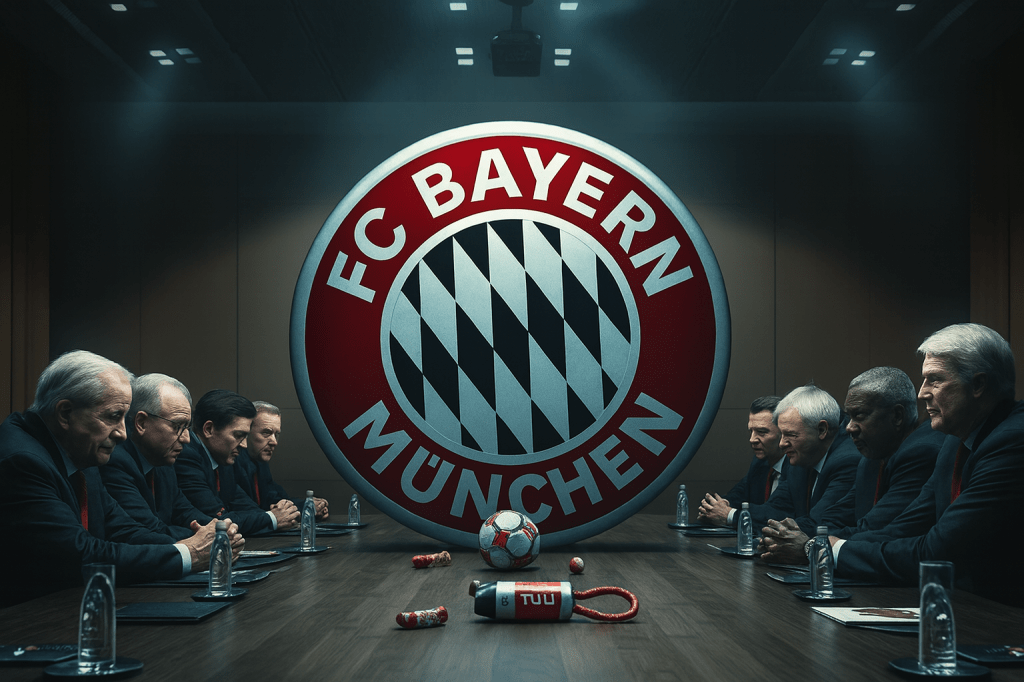
The present report will be the last ring of a chain of three parts, in which all weakness sides of Bayern Munich supervisory board and its management strategy are detailed. As reminder, the previous two parts have exposed five different weak aspects bulleted as :
(i) Single decider with outdated mentality
(ii) Average people in decisive positions
(iii) Poor medial exposure
(iv) Suspicious sparing policy
(v) Lack of long term plan and vision
The coming lines will close this analysis by emphasizing on two more aspects, number six and seven, hoping that all sides have been covered without forgetting any.
6. Unfair categorization between players
Uli Höneß belongs to the golden German generation of players in the 70s of the previous century who led Bayern Munich to three consecutive European titles and also won with the German national team the European title in 1972 followed by the World cup title in 1974 and ended as runner-up in Euro 1976 on penalty shoot-out. Along many decades, Bayern Munich has been the backbone feeding the German national team with several stars. Uli Höneß has experienced this long period of glory either as player or as manager in the club and he is still affected by this concept despite the radical changes that have occurred in modern football where clubs are able to sign unlimited numbers of foreign players besides the different cultures and football philosophies brought by foreign coaches.
Unfortunately, many incidents have proven that German players in general are still gaining a certain rate of priority in the mindset of Bayern’s honorary president especially in the recent several years after allocating huge yearly salaries (15 – 18 million euros) from Salihamdzic especially to German players: Manuel Neuer, Thomas Müller, Joshua kimmich, Leon Goretzka, Leroy Sane and Serge Gnabry. Far from the nationality aspect, one may agree that the first three names in this list have been offering considerable outputs on the pitch while it has never been the case with the last three. Although, Höneß was not worried neither about his money saving policy nor about the technical output delivered by those last three players who were receiving unlimited support; technically one of the main reasons getting Bayern knocked out from Champions League was the existence of those players.
On the other side, the Dutch center back Matthijs De Ligt who used the be the leader of the back line has been sold to Manchester United since the club is targeting to reduce salaries; the French winger Kingsley Coman has also been sold for the same reason. All key players in the midfield (Alcantara, Sabitzer, Laimer, Palhinha…) have been sidelined in a way or another (sent to other clubs or placed in other positions) to spare this position to the non-effective Goretzka near Kimmich. On another side, despite his remarkable level drop, the 29 years old German defender Jonathan Tah has been offered a four-years contract with a yearly salary of 12 million euros and also appointed as member in the players’ representatives council automatically since his arrival while the 26 years old world class French center back Dayot Upamecano has not been offered a new contract till present time accompanied with a normal and deserved raise of his salary: the club’s target in Upa’s case is to spare money as much as possible!
May be the strategy of Höneß to keep Bayern’s role as main feeder of national players to the Mannschaft is not completely inacceptable, but let it be upon robust and fair basics: only highly talented players have to be offered contracts, all players must show their qualities on the pitch, must accept their roles assigned by the technical manager and also must not cost the club mega sums of money, all players must accept internal concurrency with their mates, no player should be guaranteeing a position in the starting eleven without fighting for it.
7. Poor strategy with youth
Moving to the most catastrophic side in Bayern’s supervisory board vision, the extremely bad management and lack of clear plan towards young talents evolving in the club’s youth academy. The drastic failure is actually carried on Max Eberl shoulders and certainly his predecessors in the previous years. To be fair, Uli Höneß does not have a pronounced intervention in this management side of the club. One may agree with any club if just few young players are sent on loan one or two years to other clubs in order to gain more minutes of play and simultaneously to increase the experience, this process is normal and adopted by majority of clubs.
Nevertheless, what is completely not understandable is when a club decides to loan tens of his young talents each year to several clubs, after that, this club either continues with the loan policy from club to club and from year to year or decides to sell those talents at low fees while, at the same time the squad of this club is lacking depth and this club is sparing money and is limiting expenses to hold its financial stability. This contradictory policy has constituted the main title of Bayern Munich strategy towards his young talented players with no arguments or explanations from the supervisory board about the vision and the plan behind such decisions. Keeping buy-back options in the contracts of those transferred young players is not anymore convincing for Bayern’s fans since they historically know that any those players will go back and the club has lost them permanently except very rare cases such as Philip Lahm and David Alaba.
If one desires to list all recent cases of youth loans and permanent transfer, this might occupy considerable space in the present report. For this reason, just several pronounced cases will be cited to reflect the deep level of failure reached by the board in general and the sporting director in particular.
(i) The 24 years old defensive midfielder Angelo Stiller has been formed at youth academy of Bayern Munich between 2010 and 2021 showing promising performances. He has been surprisingly sold to TSG Hoffenheim. After his transfer to Vfb Stuttgart Stiller has become an international player in the Mannschaft, considered as the ‘’new Kroos’’ while Bayern has spent around 70 million euros for Sabitzer, Laimer and Palhiniha without any effective benefit on the pitch, this besides the bad performances offered by Leon Goretzka.
(ii) The 20 years old left winger Kenan Yildiz has spent 10 years at Bayern Munich (2012-2022) and shown excellent performance. However, the club has assessed his level otherwise and decided to sell him to Juventus Turin where he has booked a starting place and become a Turkish international player; at same time Bayern has spent 70 million euros to sign the left winger Luis Diaz from FC Liverpool without ensuring a senior back-up to him.
(iii) The 22 years old left back (and also midfielder) Frans Krätzig has joined from FC Nürenberg the youth academy of Bayern in 2017 when he was 14 years old. Krätzig’s skills have been developed and improved in the next years then he got promoted by Thomas Tuchel thanks to the technical quality and tactical awareness on the field besides his joker roles. However, the supervisory board has sent him through three loan deals (Austria Wien, Stuttgart and Heidenheim) before a permanent transfer to RB Salzburg. With the actual long injury of Davies, Kompany is struggling to find a reliable player at the left back position.
(iv) Briefly, in this summer 2025, Bayern has loaned and sold around an entire squad of young talented players despite the reduced senior squad and the money saving policy they are adopting. Here is the complete list: Bryan Zaragoza (loan to Celta Vigo), Arijon Ibrahimovic (loan to FC Heidenheim), Armindo Sieb (loan to FSV Mainz), Maurice Krattenmacher (loan to BSC Hertha Berlin), Jonah Kusi-Asare (loan to FC Fulham), Lovro Zvonarek (loan to Grasshoppers Zürich), Tarek Buchman (loan to FC Nürenberg), Gabriel Vidovic (permanent to Dynamo Zaghreb), Adam Aznu (permanent to FC Everton), Paul Wanner (permament to PSV Eindhoven), Nestory Irankunda (permement to Watford), Frans Krätzig (permanent to RB Salzburg)
In conclusion, all those lines have been written to give just and general overview of the struggling level and the pronounced mistakes and non-convenient decisions performed by the actual supervisory board. Should all details being mentioned, a complete booklet would have been filled. Bayern is still governed by only one man with the mentality of the years 70s of the previous century where all other members are there to just say ‘’yes’’. The institutional structure and the clear hierarchy are actually very far from the management board of the German giant; this would need completely new, fresh, passionate, modern, loyal and skillful people.
No one has the power to stop any flow of modernity and positive changes with this high momentum the actual football is experiencing, it is just a matter of time after which the outdated and the old will disappear and the era of the modern and the new will come, to bring Bayern Munich again on the right track.
ChroniBall XI
Where football meets data, stories, and everything in between
Enjoyed this piece? Follow us on X and Tiktok for more insights, visuals, and updates.
 ChroniBall XI
Leave a comment