
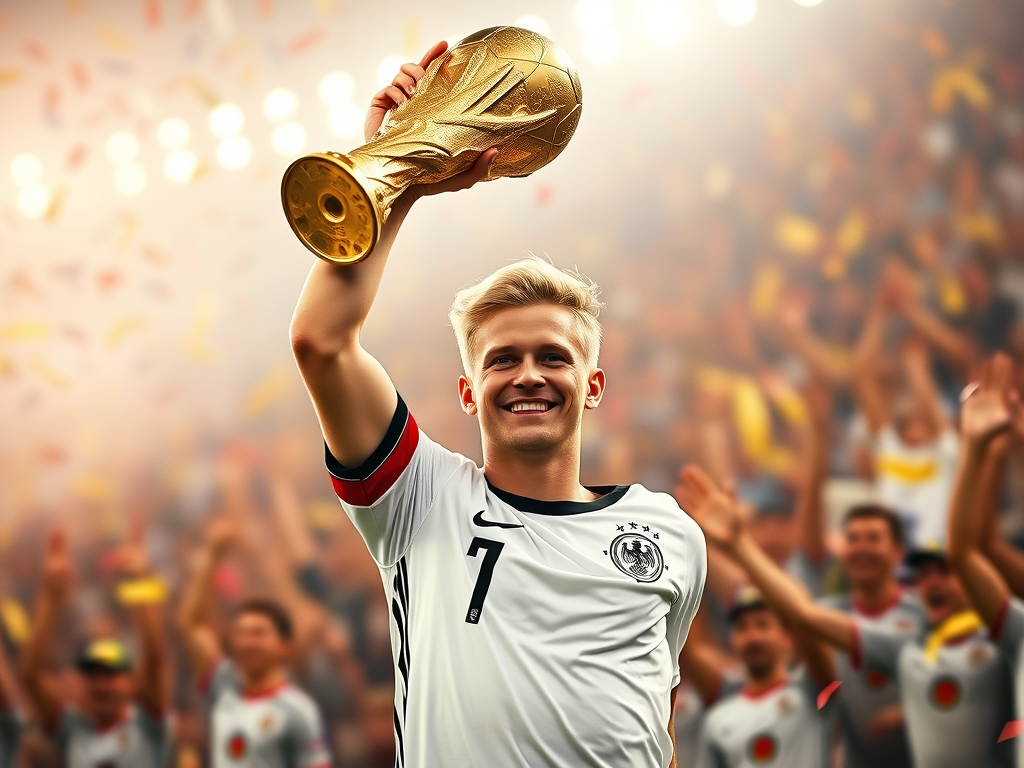
It is extremely clear for all experts who are following closely the German national team under Julian Nagelsmann since October 2023 that the team is suffering from unstable performances and results. Overall, Germany has realized during Nagelsmann’s era 15 wins, 6 draws and 6 losses. The majority of those games have been either friendly games or official games hosted by Germany, namely UEFA Euro 2024 and UEFA Nations League 2025.
Germany’s qualifying campaign
However, the FIFA World Cup 2026 qualifiers may be considered as the first serious and official campaign for the young coach Nagelsmann being played partially outside Germany. The other particularity of this campaign resides in being quite ‘’new’’ for Nagelsmann who has been qualified as host to the UEFA Euro 2024. In addition, the group stages played previously by Nagelsmann with the National Mannschaft (Euro 2024 and Nations League 2025) allow for both group winner and runner-up to qualify to the next stage while this time, only the top of the group will book the direct ticket to the USA, Mexico and Canada while the runner-up will confront a challenging play-off path in March 2026. Besides that, the six games in the group are not played consecutively within one tournament; the games are divided into three pairs played in September, October and November which reduces the common period to be spent by the players and their coach. In other words, Nagelsmann has no time to make ‘’experiments’’. He must just pick-up three points after three points either at home or away to ensure the first place in the group. Theoretically, this has been expected for Germany being in a group alongside with Slovakia, Northern Ireland and Luxemburg.
Surprisingly, it seems that all those aforementioned requirements of this qualifying campaign have increased the pressure on the shoulders of the young coach and this has been converted on the pitch by a shocking 2-0 loss in Slovakia in the opening game accompanied by an extremely poor performance technically, physically and tactically, maybe the worst among all 27 games managed by Nagelsmann. Ahead of this shock, doubts and question marks have been risen towards even the absence of the Mannschaft from the World Cup tournament after two consecutive group stage exits in 2018 and 2022. Three days later, the team has struggled to snatch a difficult home win 3-1 against Northern Ireland before adding six more points in October thanks to a large home win against Luxemburg and an extremely threatened narrow 1-0 win in Windsor Park against the Irish. This has allowed the team to be placed on top of the group with two games to be played in the present month. All in all, Germany’s destiny is in its own hands and far from any improbable miracles the team is expected to overcome Luxemburg away and Slovakia at home to book his World Cup ticket.
What’s next after qualification?
For a giant national team like Germany, reaching the world cup is never an achievement, it is a natural law. The big question is about the limits of the team within the tournament itself. Based on the actual qualifying campaign, Germany does not belong to the pool of the title contenders involving Spain, England, France, Argentina and Brazil. Those are normal expectations since at the end, experts would be based on the present performances and results to make their predictions.
The goal from the coming lines is just to give few counter-examples from the past proving a full contrast between results of Germany in the qualifying phase and its results in the tournament itself.
It is worth to emphasize that the qualifying phase is a lengthy campaign that may last many months and thus played through multiple home and away matchdays and between clubs’ competition games. Also those international games are most probably not played by exactly the same squads due to injuries, drop in some players’ levels and also apparition of other impressive players during this long period. Contrarily, the final tournament of the World Cup is played in its totality within one month after the end of the clubs’ season; the coach is responsible of selecting the players having their best forms in this period and also would be able to spend with them longer durations and arrange many training camps and friendly games. All those parameters may be decisive to make a huge difference between a qualifying phase and a final tournament.
Now, let us go back to the past and cite some contradictory results experienced by Germany between the qualification games and the world cup games.
World Cup qualifiers 1990
In that time a game winner was earning 2 points and not 3 as adopted nowadays. The qualifying system in the European zone in this campaign was consisting of dividing the teams into seven groups: four groups of five teams and three groups of four teams. In the groups of five teams all winners and runners-up qualify to the World Cup while in the three groups of four teams all group winners qualify besides two best runners-up out of three. Germany has been drawn in a group involving four teams alongside with the Netherlands, Wales and Finland.
Although Germany has not lost a single game in that campaign, the team has struggled to qualify and was on the verge of getting eliminated. Germany has gathered 9 points from three wins and three draws and +10 goal average, finished second of the group behind the Netherlands with 10 points. This means that Germany must be better than one runner-up in the two other groups: England who ended with 9 points and +10 goal average and Denmark who ended with 8 points and +9 goal average. Before the kick-off of the last matchday, England has already ended its campaign while Germany was having 7 points and +9 goal average in the account; on the other side Denmark in its group was counting one point more than the Germans with +11 goal average. All those numbers mean that under those circumstances and before the final qualifying game Germany is out of the World Cup 1990 hosted by Italy. On this last matchday, Germany was hosting Wales in Köln and in parallel Denmark travelled to face Rumania. Events have started bad for the Germans who found themselves falling behind by one early goal against the Welsh along with a simultaneous early lead of the Danish in Bucharest. Later on things have been turned around seeing Germany snatching a difficult 2-1 win with Thomas Häßler scoring the winner. On the other side, Rumania has turned the game and scored three goals to beat Denmark.
In the final tournament in Italy, Germany has shown a very impressive and convincing campaign and has gone all the way to clinch the third World Cup title in the history of the country. Curiously, they have eliminated the Netherlands in the round of 16 on their way!
World Cup qualifiers 2002
During the end of the previous century and the start of the actual century, the situation of the German national team was even worse than the German national teams of World Cup 2018 and 2022 campaigns. In December 1999, the draw has resulted in a five teams group involving England, Finland, Greece and Albania, besides Germany. The rule in that campaign states that the group winner qualifies automatically for the FIFA World Cup 2002 in South Korea and Japan, while the runner-up must book his ticket through a two-legs knock out tie against another runner-up from another group decided by a draw.
Despite the perfect start with four wins from four games including a 1-0 win at Wembley, the Mannschaft has suffered most of the times to snatch those wins and this has been confirmed by dropping two important points in their fifth game in Finland by going back from a shocking 0-2 to a tough 2-2 draw. After another difficult 2-0 win in Albania, came the disaster of Munich on September 1, 2001 when England trashed Germany 5-1 despite the lead taken by Germany very early. Consequently, England and Germany reached a state of equality of points, 16 each, but England having 6 more goals in their goal average account and thus leading the group with one matchday to go.
On that last matchday, England was hosting Greece in Old Trafford while Finland was playing in the Arena AufSchalke as guest in Germany. On that matchday, England has surprisingly gone back twice from behind against motivated Greeks to snatch an equalizer in the injury time thanks to a David Beckham’s geniously played free kick. In the parallel game, the Germans were supposed to accept this generous Greek gift and beat Finland at home to finish at top. However, Germany refused to stop this disappointing qualifying campaign and offered a passive performance with toothless attacking style to end this phase with a goalless draw and thus going to the play-offs to face stubborn Ukraine with their star Andriy Shevchenko under a real danger of being absent from a World Cup tournament since decades.
After picking-up a 1-1 draw in Kyiv, Germany led by Michael Ballack, has ended completely the job in Dortmund by leading 3-0 in the first quarter hour of the game and finishing the confrontation 5-2 on aggregate. Germany was the country number 29 out of 32 to reach the World Cup.
In the tournament itself, Germany has shown another face. The Mannschaft was not that shining with a fascinating style of play, but it was a really solid, compact and disciplined team hard to be beaten. This has allowed Germany to reach the final with just one goal conceded but without their booked star Ballack. In the final game, the unexpected mistake from the tournament MVP Oliver Kahn has contributed to this 2-0 loss against Brazil. Nevertheless, and against all predictions, Germany has secured surprisingly the silver medal, reaching a very advanced stage, much better than the favorites contenders France and Argentina being knocked out from their groups and even England whose campaign has ended at the quarter-final stage.
World Cup qualifiers 2018
A completely opposite case to the previous ones may be represented through the 2018 qualifying campaign where Germany was drawn in the same group with Czech Republic, Norway, Northern Ireland, Azerbaijan and San Marino. In this campaign, the title holder Germany ranked 2 in the world according to FIFA ranking has made an outstanding qualifying phase smashing all opponents home and away, realizing 10 wins out of 10, scoring 43 goals and conceding just 4 to end at the top of the group and qualify automatically to FIFA World Cup 2018 in Russia being categorized among the favorites to clinch the title for the second consecutive time.
In the group stage of the final tournament, Germany has surprisingly lost the opening game against Mexico 1-0 offering an average performance before snatching at the death the 2-1 win against Sweden to keep one of the astonishing surprises in the World Cup history to the last matchday in the group by losing 2-0 against South Korea, both goals falling in the injury time of the game. Germany ended at the bottom of the group and has been knocked out at this stage for the first time since 1934.
Other counter-examples
This contradiction between qualifying and final tournament results has been experienced by many national teams throughout the history. Briefly speaking, here are other examples:
- Colombia has played an outstanding qualifying campaign towards World Cup 1994, leading their group in front of Argentina without any loss; they got knocked out from the group stage in the World Cup losing to Rumania and USA.
- Argentina has ended the qualifying campaign towards World Cup 2002 in an impressive manner, losing just one game out of 18 and presenting themselves as the number one favorites to win the title before being shocked in the group stage by Sweden and England.
- Contrarily, in the same campaign, Brazil has struggled when losing one-third of its qualifying games and was forced to wait till the last matchday to secure the World Cup ticket. However, in Korea and Japan, they scored seven wins out of seven to clinch their fifth World Cup title.
- Staying in the same World cup campaign but in the European zone, Turkey ended as runner-up behind Spain and forced to go through the play-off games. The Turks have succeeded to go past Austria and pick-up the bronze medal in Korea and Japan.
- In the 2018 qualifying campaign, Croatia has suffered and ended runner-up behind Iceland and was under danger of absence from the World Cup, but they made it by overcoming Greece in the play-off legs. In the tournament, they have reached the final game and secured the silver medal.
All those cited examples do not definitely guarantee that Germany will change 180 degrees and clinch the title, but do not also write them off completely. It is all about Nagelsmann! First he must secure the six points from the last two games and qualify automatically. Then he has to select players upon their actual forms and not their ‘big’ names. Hereafter he must avoid experiments and get inspired from players’ roles in their clubs to build his tactics. An important parameter also, he has to rely sometimes on opinions of experimented people, like Rudi Völler. Additionally, he must benefit to the maximum from the limited time he has with the team ahead of the tournament: just two friendlies in March and two others just before the competition. When he regulates all those settings, the German machine would work and be brought on the right track.
A tournament similar to the 2010 one would be exceptional and promising!
ChroniBall XI
Where football meets data, stories, and everything in between
Enjoyed this piece? Follow us on X and Tiktok for more insights, visuals, and updates
 ChroniBall XI
Leave a comment