
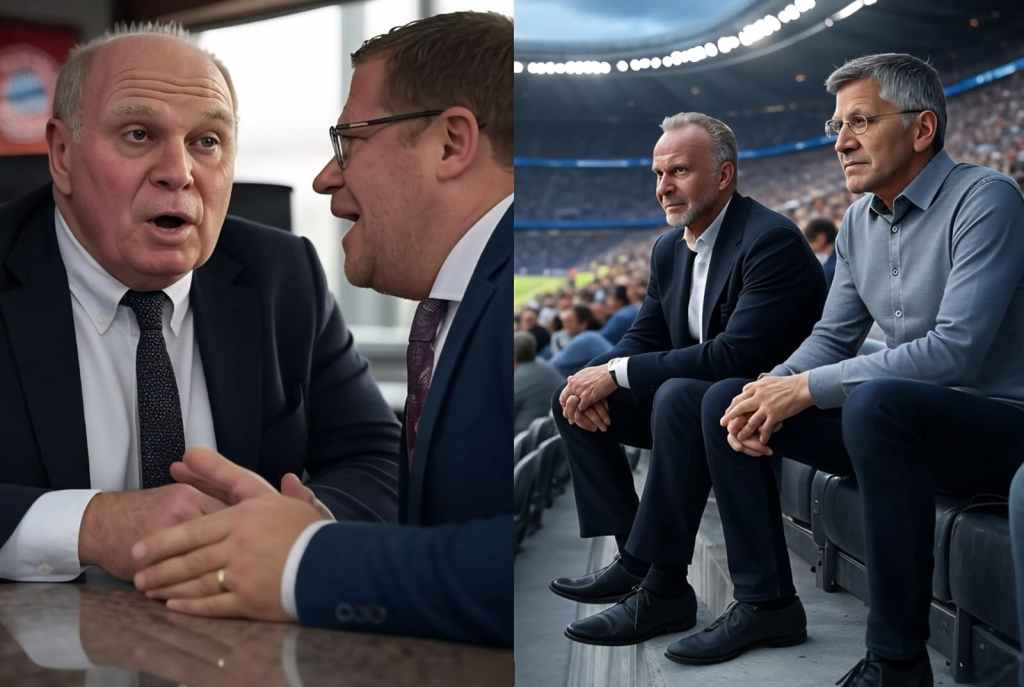
Since several decades, despite the existence of apparent managerial boards, Bayern Munich has been governed effectively by two people who have been taking all the key decisions, setting the financial policies, preparing plans for squads ‘construction and youth academies, negotiating other clubs for new signings and players selling and also being the medial face of the club. Those two people are no other than Uli Höneß and Karl-Heinz Rummenigge.
To be objective and as neutral observer, both men should be assigned valuable credits due to the achievements they have reached within the club towards exemplary managerial, financial and technical stability set in Bayern Munich, which has allowed the club to ranked throughout all those years among the elite clubs in Europe and the world alongside with Real Madrid, FC Barcelona, FC Liverpool and AC Milan.
Nevertheless, any golden era led by even exceptional people in any professional field within any type of institutions, should naturally have an expiry date and progressive changes must be brought there in order to keep ‘’life’’ and ‘’freshness’’ in this institution which conserves its stability, sustainability and ability to compete with other institutions. When this expiry date, and against the normal rules, gets indefinitely prolonged and governing people try to keep their positions in the institution beyond this expiry date, this original golden era will turn to result into opposite consequences and the institution will experience frequent moments of failure that may diverge into collapse if no saving measures are taken. This is what is the giant FC Bayern Munich actually suffering from, and the coming lines will try to clarify in details this dilemma in the club’s managerial board.
In the last decade, with the Guardiola era approaching in Bayern to its end, Rummenigge got quite distanced from the club’s management due to other commitments meaning that the lone powerful man in the club has remained the president (and later on honorary president) Uli Höneß; all people occupying all other key positions in the club, either the CEO, the financial manager, the sporting manager or the head coach, have to ‘’obey’’ his ‘’recommendations’’ otherwise they will be thrown outside the walls of the Säbener Straße. Managing a giant club like Bayern Munich in this toxic spirit has remarkably impacted the status of the club on all levels, namely just after Hans-Dieter Flick’s sextuple of 2020.
Many managerial aspects applied in the club, are enough to let any closer analyst aware of the falling and the failing path followed by FC Bayern Munich throughout the recent years; certainly due to weak management methodology adopted by Höneß and his working team. In this first part of this report two aspects will be emphasized, while the remaining will be detailed in coming parts II and III.
1. Single decider with outdated mentality
Many incidents that have occurred in the club in the recent years have confirmed that, with all respect, all responsible and the supervisory board managing the club are just a cosmetic appearance for media, fans and football community conviction while the key decisions in the club are still in one hand and all the rest have to agree.
In addition, the powerful Höneß who will turn 74 in coming January, is still managing the club with the same mentality of management 25 or 30 years ago without considering how fast international football is evolving on multiple sides: financial level, marketing level, scouting level accompanied with statistical data, new mentality of ambitious German stars who are looking to build their careers outside the German borders. All those heavy managing tasks have to be in hands of younger, more active, more flexible but charismatic people able to remain up-to date with modern dynamic actual football domain. To cite some incidents proving this powerful dominance of Bayern’s honorary president:
(i) the visit of Kompany and Eberl to Höneß’ place (not even within the club’s offices) asking his permission to bring Xavi Simons, ignoring the decision of any council or any hierarchy in the club
(ii) the personal and permanent presence of Höneß during negotiations with Florian Wirtz ignoring the role of the sporting director and the head coach (old way to do things like 80’s and 90’s of the previous century)
(iii) the veto imposed (via media and not even internally) by Höneß in the last few days of this mercato 2025 on any permanent deal with any player, requesting exclusively a loan without an obligation to buy despite that the squad construction plan has to be set by the sport director in coordination with the head coach.
2. Average people in decisive positions
Honestly speaking, all credit is given to Uli Höneß who is really seeking skillful people in all key positions, able to lead the club in the future keeping its financial stability on one side and also its place among the elite clubs in Europe and the world. Unfortunately, the degradation path followed by the club is a clear indicator to Höneß’ poor choices.
Starting with Hasan Salihamdzic, the ex-sporting manager who received full support of Höneß despite his clear lack of abilities in management and absence of experience (he has never worked in this position before). Although Salihamdzic has brought some good signings to the club but globally the technical build-up of the squad was lacking of talented players in many positions especially in the midfield besides lack of many talented back-up players; in addition, it was Salihamidzic who has offered very long term contracts to a certain group of players with huge salaries that do not correspond to their outputs on the pitch and Bayern is still financially suffering from this impact. It should be noticed that Salihamdzic has not been recruited by any big or average club since he quitted Bayern in 2023.
Moving to the actual sporting manager Max Eberl which was the target of Höneß in the past, one may easily notice that the managerial and technical problems in the club are not reducing at all. Another disappointing choice from Höneß. Lack of charisma in negotiations, lack of clear vision in squad construction, absence of effective statistical data of target players, lack of scouting of non-standard talents (that are far from medial spot and from eyes of big clubs, like those who evolve in South America, Africa, or average European leagues), bad management and promotion of young players are still characterizing Eberl era. Adding to this the non-efficiency of Christoph Freund who has failed namely in the deals of Bryan Zaragoza and Sasha Boey, without forgetting the weak effects of Hainer and Dreesen who are not bringing any concrete added value to the club.
The club is really needing new fresh blood coming from ex-players who have given a lot on the pitch and are able to do this in the offices of the club: Philipp Lahm, Thomas Müller, Mario Gomez and Bastian Schweinsteiger are few examples.
Football fans who are really interested in pursuing this analysis, are invited to wait for parts II then III that should come in the near future, hoping that this first part was enjoyable and beneficial for them.
ChroniBall XI
Where football meets data, stories, and everything in between
Enjoyed this piece? Follow us on X and Tiktok for more insights, visuals, and updates.
 ChroniBall XI
Leave a comment