
In the last two decades, it has been clearly noticeable to the majority of football experts, the ups and downs that have accompanied the Italian football in general, and the Italian national team in particular. Starting this two-decades period with the peak of clinching the fourth FIFA World Cup title in 2006, the Squadra Azzurra has suffered a series of disappointing results starting by the poor group stage in UEFA Euro 2008 before get knocked out by Spain in the quarter-final then the group stage exit from both FIFA World Cup 2010 and 2014. The deepest point in this collapse has been revealed by failing twice in the qualifiers to FIFA World Cup 2018 and 2022 against Sweden and North Macedonia respectively, opponents who normally should not prevent Italy from showing up as one of the best 12 European teams eligible to represent Europe in a FIFA World Cup. The last episode of this disappointment resides in the catastrophic performance and results offered during UEFA Euro 2024, ended with a deserved loss against Switzerland in the round of 16. Some bright spots have punctuated this long chain of failures namely the impressive campaign in UEFA Euros 2012 and 2016 that ended respectively as runners-up and at the quarter-final stage and the European championship title lifted in UEFA Euro 2020.
Italy’s Post-2006 Decline
After being crowned world champions in 2006 and despite some brief successes during the last two decades, it is easily remarkable that the general path of the Squadra Azzurra throughout the years is following unfortunately a downward tendency.
Starting with the coaching level degradation, Italian football has offered historically genius names among which Arrigo Sacchi, Fabio Capello, Marcello Lippi and Claudio Ranieri (two of which have led the Italian national team). In the past several years, one may find that just good coaches (instead of giant) are taking charge of the national team, like Cesare Prandelli, Antonio Conte and Roberto Mancini to reach finally a series of average coaches namely Roberto Donadoni, Gian Piero Ventura and Luciano Spaletti.
Same trend may also be noticed through the different positions in the team.
+ Defensively, the transition has started from the giants Fabio Cannavaro, Alessandro Nesta and Marco Materazzi to the strong Giorgio Chiellini, Leonardo Bonucci and Adrea Barzagli, arriving to the ‘’acceptable’’ Alessandro Bastoni, Riccardo Calafiori and Giovanni Di Lorenzo.
+ Moving to the midfield, two decades ago Italy had at its disposal world class names the likes of Andrea Pirlo, Francesco Totti, Massimo Ambrosini and Marco Verratti while the ‘’upgrade’’ in this line several years later has resulted to quite one grade lower names, to cite few, Thiago Motta, Riccardo Montolivo, Claudio Marchisio and Emanuele Giaccherini. In the present time, this Italian midfield line is occupied by names who, unfortunately, are not able to lead their country competing with the heavyweight national teams, for instance one may mention Federico Dimarco, Sandro Tonali and Nicolo Barella.
+ Arriving finally to the Italian attacking line, 20 years ago Italy was teeming with outstanding attackers, as few examples, Alessandro Del Piero, Filippo Inzaghi, Luca Toni and Alberto Gilardino; those players have been replaced in the last decade by just promising skillful names like Mario Balotelli, Ciro Immobile, Lorenzo Insigne and Sebastian Giovinco. Nowadays, this line is occupied by players who are unfortunately distanced from the levels of their predecessors: Giacomo Raspadori, Federico Chiesa, Mateo Retegui, Daniel Maldini and Moise Kean may not be compared to the older Italian generations.
+ The Italian goalkeeping may appear as the lone field to be exempted from this drop: either Gianluigi Donnarumma or Michele Di Gregorio have proven their class and consistency.
Now, before moving into metrics and numerical comparisons in the coming lines, one may cite several reasons (personal analysis) behind this Italian drop:
◘ The apparition of Pep Guardiola’s philosophy with his dream team FC Barcelona in 2008 has been a kind of revolution in football system (similar to the effect of the total football set by the Dutch in the 70s of the previous century); a philosophy based on high press, quick passing, dynamic positions change and high dribbling skills and ball possession. This has opened a new era in football tactics. The majority of the big teams either on clubs’ or national teams’ levels have integrated many aspects of this philosophy in a way or another within their senior squads and youth academies; besides Spain, one may talk about Portugal, France, England and Germany. The exception has been Italy who opted to keep their traditional football basics built especially on the catenaccio school. This has remarkably increased the gap technically and tactically between Italy and the remaining big teams throughout the years.
◘ The technical and financial drop of the Italian Serie A league (which has been the prime European league during the 80s and the 90s of the previous century) in front of the English Premier League with its giant financial investors and the Spanish Liga being the top industry of talents, has impacted directly the Italian national team which is mainly fed from Serie A players. The Italian league has not been appealing anymore to world class stars in the last two decades.
◘ The lack of Italian shining talents has declined the interest of big clubs in Italian players. One may notice how rare it is that any English or Spanish big club being interested in signing Italian players. In the past, the big Italian clubs like Juventus, AC Milan, Internazionale, Napoli and Roma were filling this gap and feeding the national team. Actually all those teams are struggling on all levels. As indicator, the Italian squad in UEFA Euro 2024 was involving just 3 players out of 26 evolving outside the Serie A, two of them being goalkeepers.
The remaining parts of this reports are devoted to measure in metrics the evolution of the Squadra Azzurra throughout the last 20 years, considering exclusively the official games which include FIFA World Cup qualifiers and final round, UEFA Euro Qualifiers and final rounds, Confederations cup and UEFA Nations League.
Measuring The National Team’s Evolution
Global Metrics
Overall, Italy played between 2005 and 2025 a total of 176 official games, won 102 (i.e. 58%), drew 49 (i.e. 28%) and lost 25 (i.e. 14%), scored 300 goals (i.e. 1.7 goal per game), conceded 145 (i.e. 0.82 goal per game), ended with 78 clean sheets (i.e. 44.3%).
However, by zooming in a more interesting side within those 176 games, where Italy have faced one of the heavyweight European nations (namely Spain, France, England, Germany, Netherlands and Portugal), one finds that Italy has played in the last two decades 37 official games against the aforementioned teams, won 9 (i.e. 24%), drew 15 (i.e. 41%) and lost 13 (i.e. 35%), scored 38 goals (i.e. 1.02 goal per game), conceded 50 goals (i.e. 1.35 goal per game), ended with 9 clean sheets (i.e. 24%)
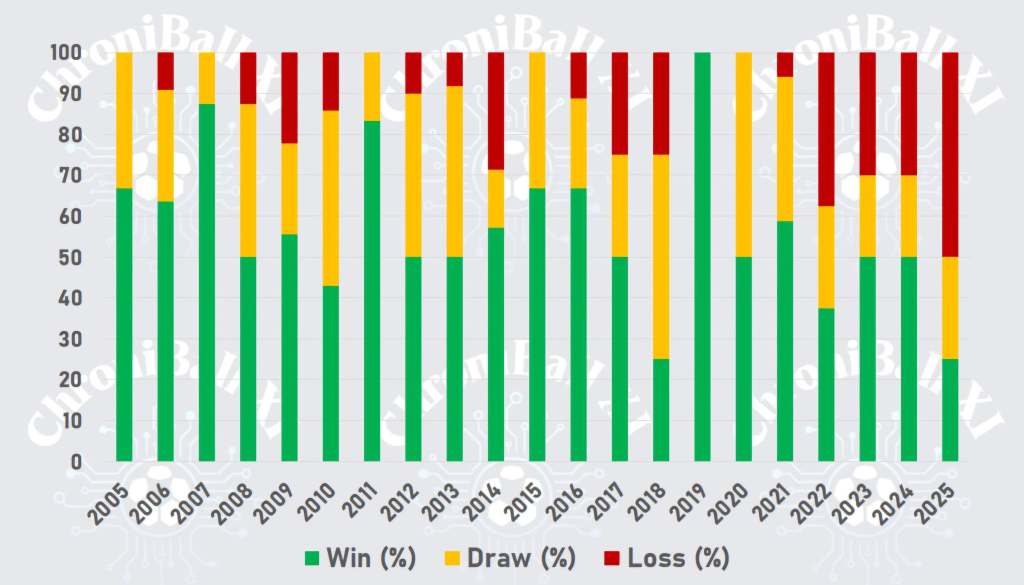
The bar chart shown illustrates in detail the percentages of wins, draws, and losses scored by the Italian team, year by year, from 2005 till June 2025. Disregarding 2019 with the terrific momentum imposed by Mancini at his debut and the poor levels of the opponents, one may remark that just after UEFA Euro 2016 the ratio of wins has never exceeded 50%, with the exception of UEFA Euro 2020 which although remained less than 60%; simultaneously the loss rate has ranged between 40% and 50% in the last four years. This indicates indeed the weak trend line of the Azzurri in the last eight years. Before UEFA Euro 2016, the bars levels reveal lot of inconsistency in performance where the highest percentages of wins remain around 2006, the year of the world cup title.
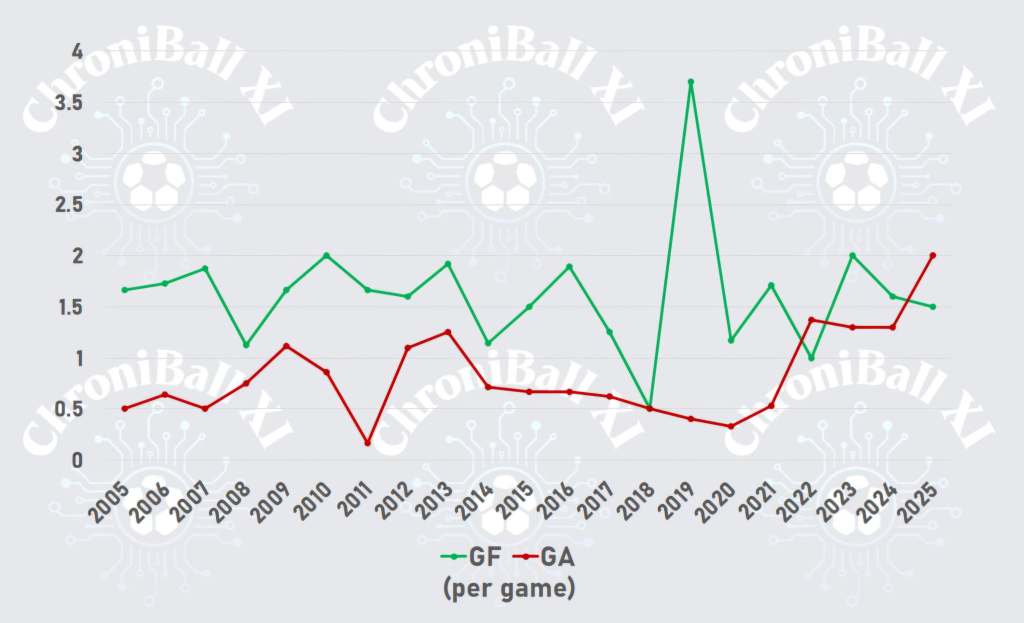
The other broken lines chart also shows another aspect: goals scored (in green) and conceded (in red) per game. Always disregarding 2019 (3.7 goals/game which seems a pronounced exception statistically speaking besides the reasons stated above), Italy has barely scored 2 goals per game just in 2010 and 2013 facing majority of humble and average opponents (except scoring two in Brazil’s net; failing to score against Spain). Maybe the lack of goals abundance has characterized Italian football throughout its history meaning that Italy has built its glory thanks to solid and compact defensive lines measured by the red trending line illustrating quite a similar trend to the bars chart: before UEFA Euro 2020, Italy has rarely conceded more than one goal per game while the opposite trend is observed after 2020 indicating the drop in quality of the defensive ‘’pivot’’ on which Italy has counted.
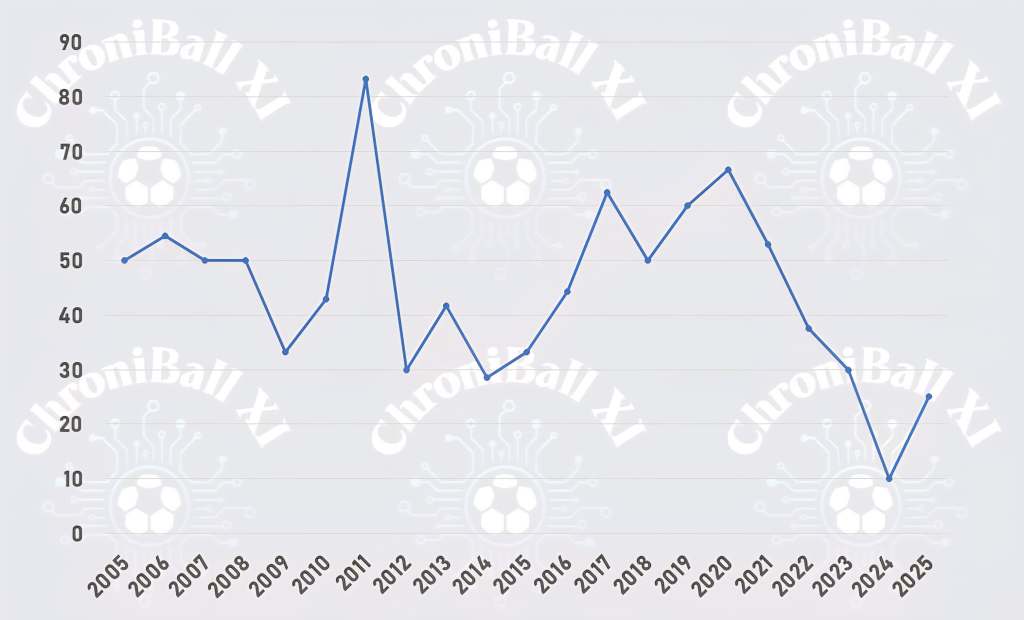
In addition, it is interesting to observe the percentage of games Italy ended as clean sheet between 2005 and June 2025 given that the strong point of all Italian teams in general resides in their defensive philosophy of play. The chart below reveals this evolution which appears to be in line with the other metrics discussed above. Before UEFA Euro 2020, this rate is oscillating up and down exceeding remarkably 50% only four times in 20 years, and going slightly above 50% just twice knowing that around 80% of the official games (i.e. 139), Italy has faced average and poor national teams. After UEFA Euro 2020, this rate has reached low values (around 35% and below) making all experts quite surprised watching that the path towards the Italian net is not that tortuous anymore.
Do you think that it is everything about Italy’s metrics in the last two decades? The most interesting data are yet to come in the part II of this analysis, where a detailed comparison between Italy and several giant European football nations will be exposed. Do not miss the upcoming article!
ChroniBall XI
Where football meets data, stories, and everything in between
Enjoyed this piece? Follow us on X and Tiktok for more insights, visuals, and updates.
 ChroniBall XI
Leave a comment