
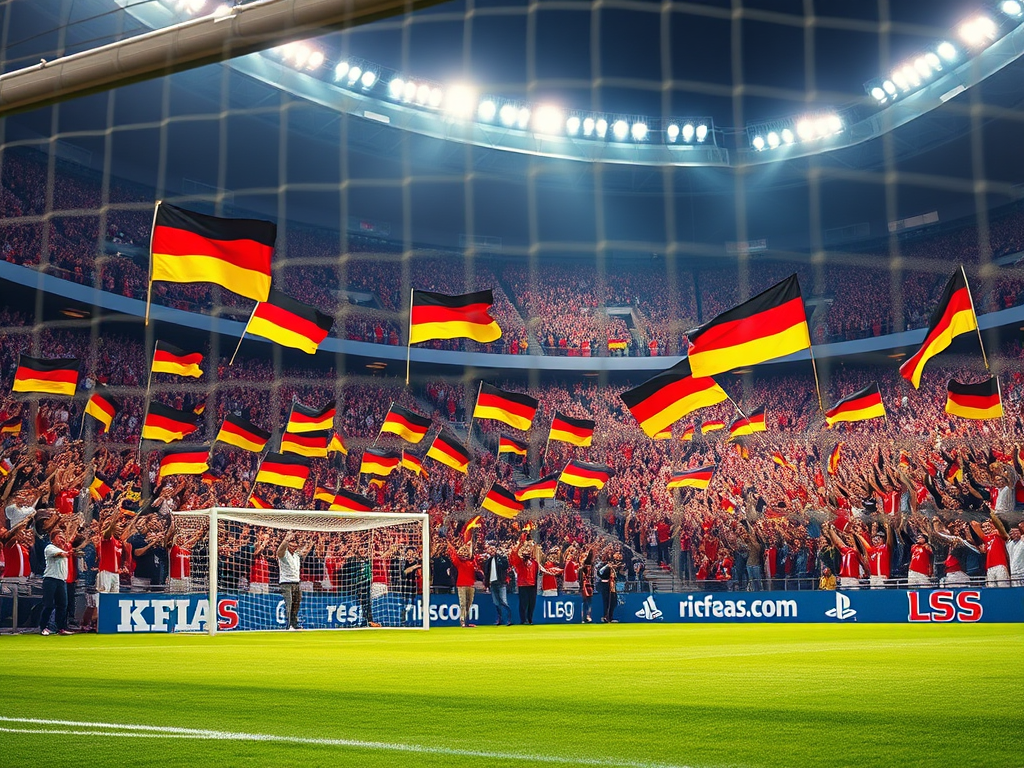
Since the FIFA World Cup 2018 up to the present time and the German national team is suffering from inconsistent performance and results. Five times Germany has been knocked out from group stage (World Cup 2018 and 2022; Nations League 2019; 2021 and 2023) and once from the round of 16 (Euro 2020). Three technical managers at the head of the team have been changed in this period. The team has scored several catastrophic and also historic results among which the 0-6 humiliation against La Furia Roja in November 2020 in the Nations League group stage, the 0-2 loss against South Korea in the group stage of the FIFA World Cup 2018 and the two successive losses against the other Asiatic team, Japan: 1-2 in the group stage of the FIFA World Cup 2022 and then 1-4 in a friendly game in Wolfsburg.
The struggling of Die Mannschaft has seemed to come to an end thanks to the convincing and stable performance and results achieved when they hosted the last version of the UEFA Euro last summer despite their unlucky and unfair exit against Spain in the quarter-final who have been crowned champions of this competition. Germany was a serious contender to the title. They have performed much better than many other giant nations like France, England and Portugal. This light of hope has been then endorsed by the outstanding Nations League 2025 campaign either in the group stage or in the two quarter-final legs. This campaign has revived the faith that the team is back on the right track with increased hopes to win the first title since 2017. However, the disappointing home losses against Portugal in the semi-final and against France in the bronze-medal game have awakened again the old bad memories of the period just before 2024.
Several analysts, experts and bloggers have interpreted this drop of level easily by the actual absence of talents in Germany, without going into details and providing arguments. How can it be when the U21 German team reaches the semi-finals of Euro 2015, ends as finalist in Euro 2019 and 2025 and wins the European title in 2017 and 2021? How is Germany lacking of talents when the U17 team wins both UEFA Euro 2023 and FIFA World Cup 2023 within six months’ margin? Why are the majority of the U19 players, European champions in 2014, not actually feeding the senior national team? How have been the DFB scouting teams, and respectively the head coaches, following-up all those players? How have they been planning the technical and tactical development of those talents? Have they really made their ‘’homework’’ in management and scouting? Why a certain group of players, despite their pronounced level drop several years ago, are still called to the national team, and even constituting the backbone of the Mannschaft?
Certainly under Julian Nagelsmann direction, several players like Joshua Kimmich, Antonio Rüdiger, Nico Schlotterbeck, Jamal Musiala, Florian Wirtz and Tim Kleindienst have already convinced with their high quality and added value to the team. Although, it is noticeable that the team is still lacking talented players at some key positions to be able to compete with the big football nations: namely the full backs, the defensive midfield and the wingers.
One has the full right to wonder why Nagelsmann is still not considering talents from junior national teams to be promoted. From the U21 team, except Nick Woltemade, players like Brajan Gruda, Nathaniel Brown, Paul Nebel, Nelson Weiper, Rocco Reitz and Paul Wanner are still ignored. Even the U19 team may suggest some interesting names like Noah Darvich, Paris Brunner, Assan Ouedraogo, Said El-Mala and Max Moerstedt.
Although the natural improvement process of any team is a continuous and smooth promotion of players from junior to senior team and the expected steps from any head coach is to call talented players from youth teams, the coming lines will just show comparative statistics between actual players in the senior Mannschaft (who are unfortunately not bringing any remarkable added value) to other players who might have been given at least an opportunity during the final four round of the UEFA Nations League 2025. To take the worst case possible scenario, the selected players do not even belong to the actual U21 and U19 squads (unavailable in June due to the commitment to their respective UEFA Euro competitions). Those names, intentionally selected outside the junior teams as few examples, emphasizes the choices versatility existing in Nagelsmann’s hands. It should be noticed that statistical data are related only to the league games covered by those players, since not all concerned clubs have been involved in European competitions.
Full backs
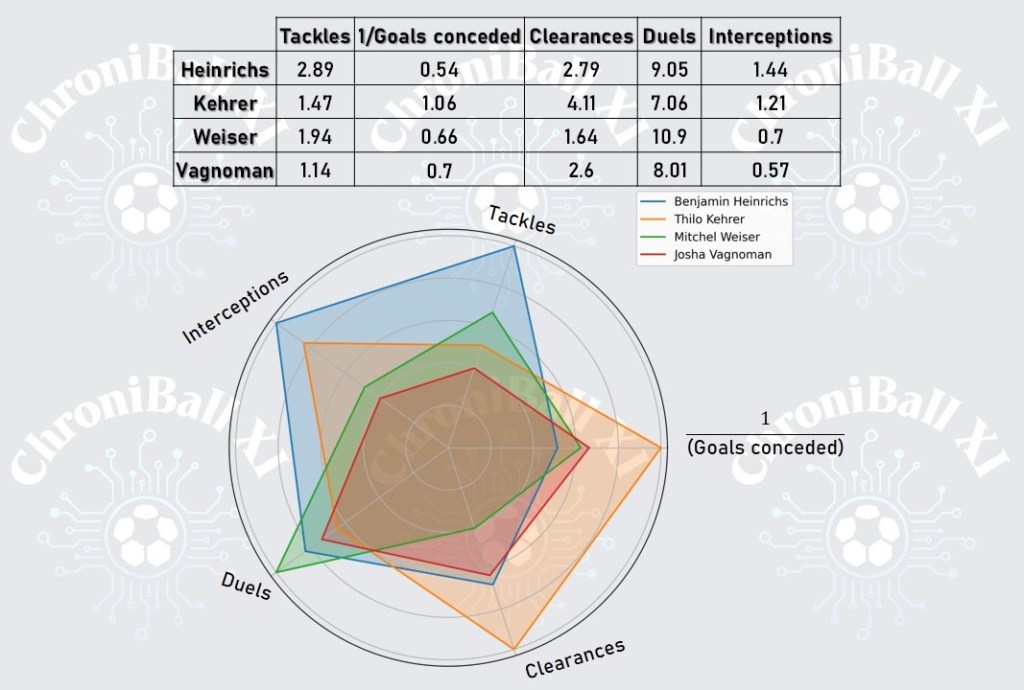
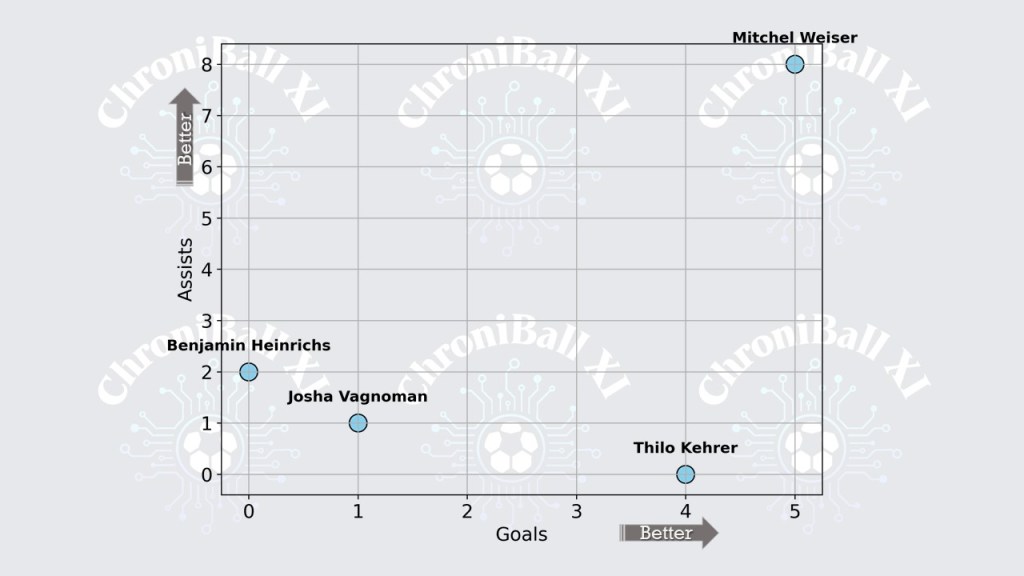
Starting by the right back position, the German captain Joshua kimmich is occupying this position, unlike his role as midfielder in his club Bayern Munich. Shining offensively but with defensive weakness, kimmich seems to be the best option actually. Recently, his back-ups have been either Benjamin Heinrichs (28, RB Leipzig) or Thilo Kehrer (28, AS Monaco), both failing to convince, especially against big teams. This report, and far from young players’ promotion (which has to occur as soon as possible) has picked up two other potential options, former U19 and U21 players Mitchell Weiser (31, SV Werder Bremen) and Josha Vagnoman (24, Vfb Stuttgart), whose defensive (per 90 minutes) and then offensive (global) stats in the graphs below show that they may be able to replace both Heinrichs or Kehrer and have deserved to take their chances in the national team. A last point to pay attention to, is that the teams levels in the Bundesliga are in general quite better than Ligue 1 teams, this may mask some metrics, that appear advantageous for Thilo Kehrer.
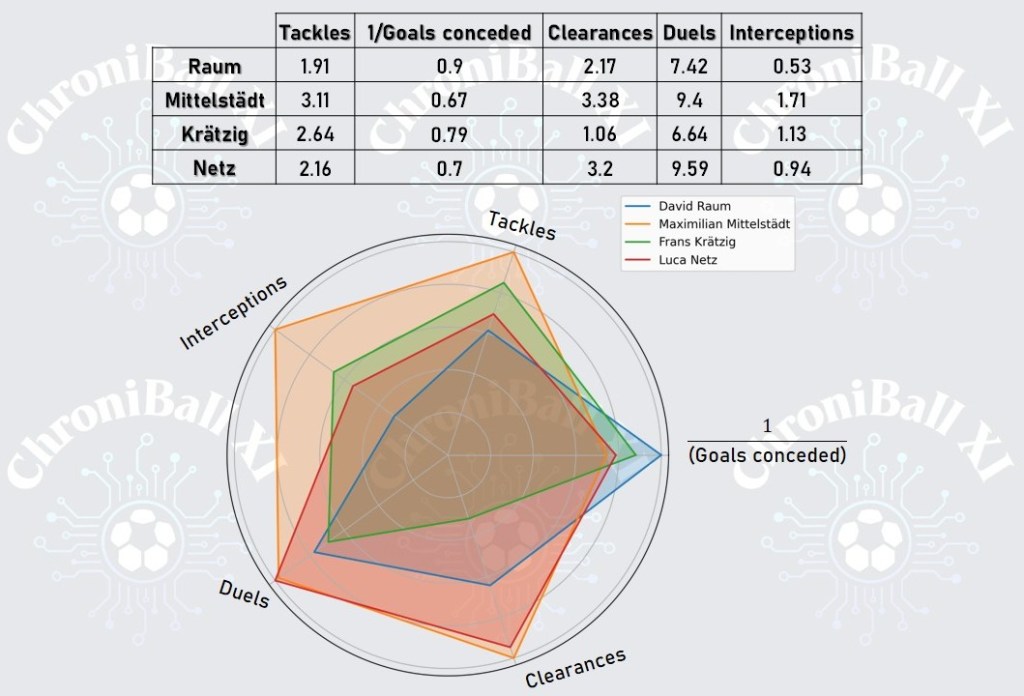
Moving to the left side of the German defense line, the continuous switch between Robin Gosens (30, Fiorentina), Maximilian Mittelstädt (28, Vfb Stuttgart) and David Raum (27, RB Leipzig) reveals that Nagelsmann has not yet converged to a convincing name for this position. The last two games in the Nations League have undoubtedly confirmed that Gosens is out of form to represent Germany anymore, while Raum and Mittelstädt are showing unstable and average performances. The graphs below, with same structures as the right backs, suggest two potential alternatives who might be called by Julian Nagelsmann: Franz Krätzig (22, RB Salzburg) the former Bayern Munich and Heidenheim left back who has shown good skills during Thomas Tuchel era, and Borussia Möchengladbach’s Luca Netz (22, B.M.Gladbach) who used to represent Germany in U15, U17 and U21 teams.

Defensive Midfield
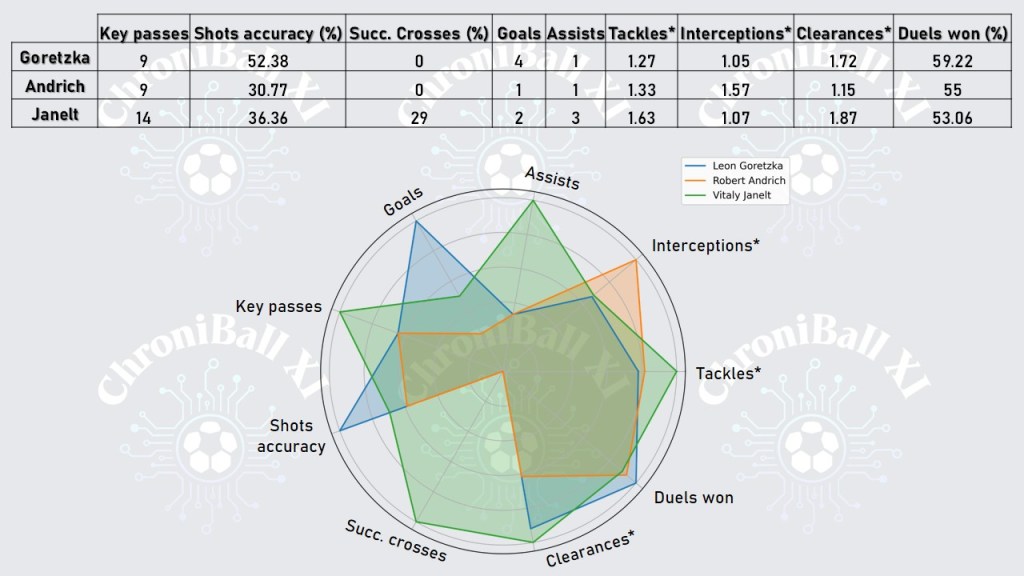
This critical line in any football team, consisting of positions six and eight, may be termed the ‘’team’s engine’’. The spot of light in this dark tunnel for Germany resides in the trust that Nagelsmann is placing in promising names, in particular Angelo Stiller, Aleksandar Pavlovic and Tom Bischof, besides the veteran Pascal Groß. Nevertheless, the insistence of Nagelsmann on keeping some names like Leon Goretzka (30, FC Bayern Munich) and Robert Andrich (30, Bayer Leverkusen) is raising criticism among German experts: Andrich’s level has dropped remarkably this season with Leverkusen compared to the last one, while Goretzka has rarely shown quality except during some games against humble opponents. Curiously, since 2020, Bayern Munich has failed to reach any UEFA Champions League semi-final with the combination Kimmich – Goretzka in midfield. Tuchel has relied on the duo Laimer – Pavlovic in the semi-final against Real Madrid last season. A potential replacement may have been picked up from the English Premier League, a certain Vitaly Janelt (27, Brentford FC) who also played in all junior teams for Germany. Furthermore, some reports have stated that the former head coach Hansi Flick was on the verge of considering him in the squad. The stats shown below (the asterisked metrics measured per 90 minutes), compare some parameters between the three players, keeping in mind that Janelt is evolving in a more challenging and competitive league compared to the German Bundesliga.
Wingers
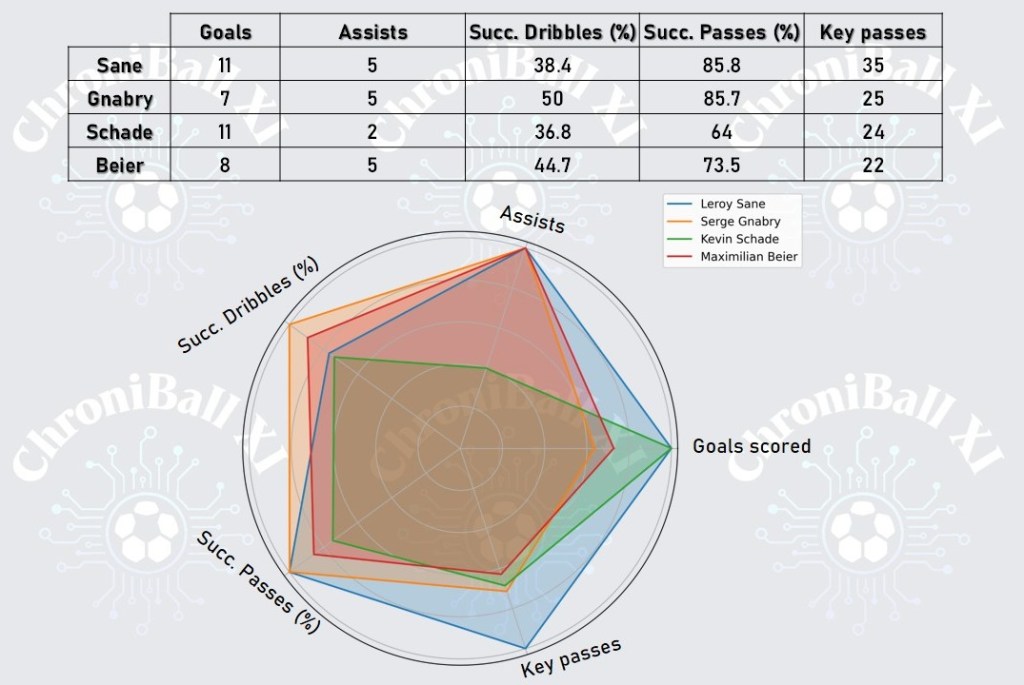
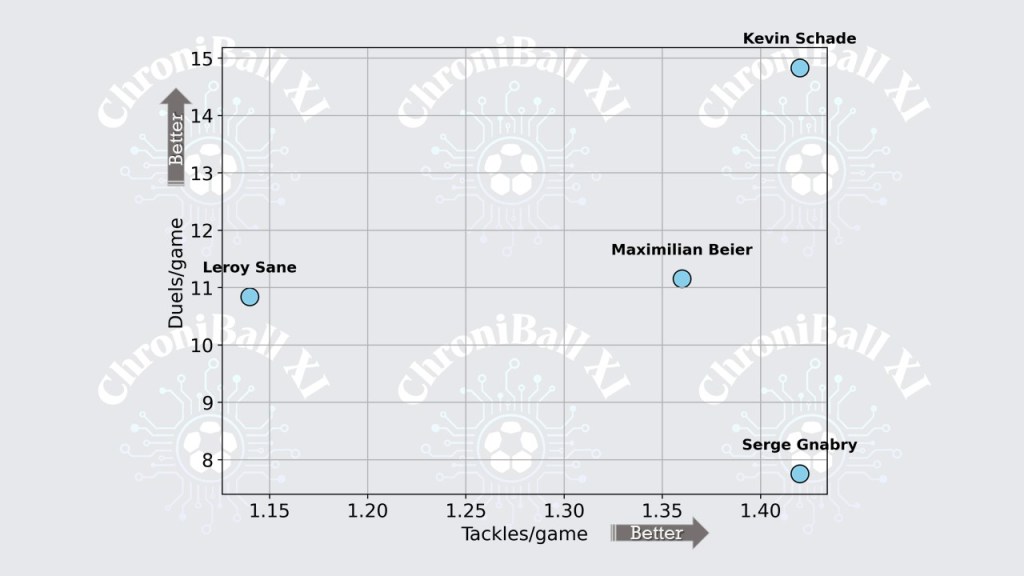
The long absence of Kai Havertz due to successive injuries alongside with the conflict of positions between Jamal Musiala and Florian Wirtz on the pitch especially in tough games (for instance Nagelsmann has started with Wirtz on the bench against Spain) have imposed the necessity of reliable and active wingers in the team. With Karim Adeyemi seeming an acceptable option despite some weaknesses whose discussion is out of scope now, the indefinite trust placed in the duo Leroy Sané (29, FC Bayern Munich) and Serge Gnabry (29, FC Bayern Munich) despite their poor contribution with Bayern Munich as well with the Mannschaft is completely not understandable. Nagelsmann is certainly risking the success in FIFA World Cup 2026 campaign if he is still planning with them. Regardless the U21 and U19 actual talents, this report is comparing in the graphs below some offensive and defensive metrics with those of two potential alternatives, Kevin Schade (23, Brentford FC) and Maximilian Beier (22, Borussia Dortmund), with Schade obviously evolving in a more challenging league.
Goalkeeping
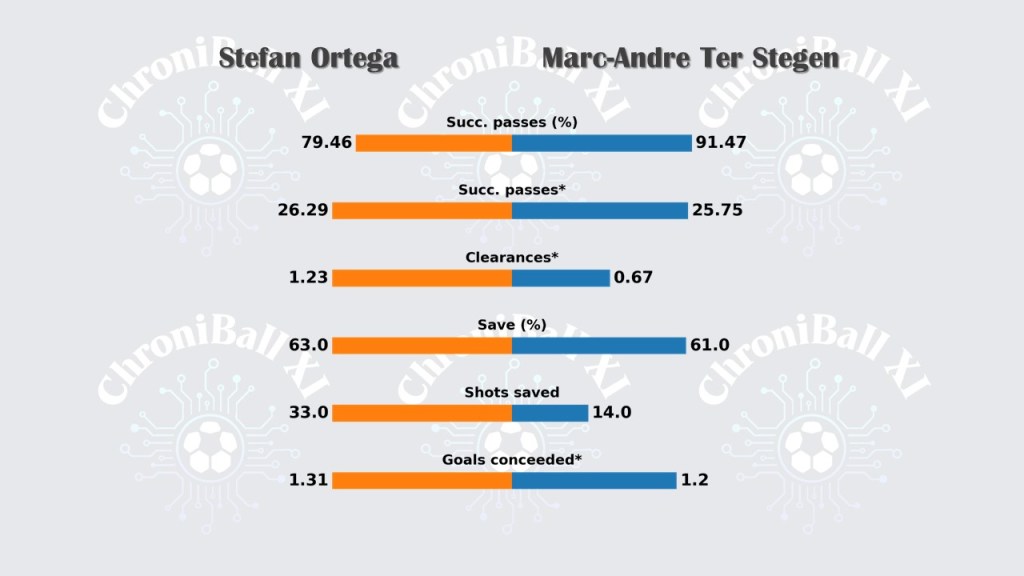
After the retirement of Manuel Neuer from international career, it was logic to count on the available options, namely Alexander Nübel and Oliver Baumann who have shown satisfying performances in this campaign of the UEFA Nations League. However, the controversial point is the nomination of Marc-Andre Ter Stegen (33, FC Barcelona) as number one and fielding him against two heavyweights like Portugal and France! Besides the poor performance this season and his removal from the future plans by his club FC Barcelona, Ter Stegen stood on the pitch just nine times with his club! For the sake of fairness, the graph below (the asterisked metrics measured per 90 minutes) is comparing Ter Stegen numbers with those of a goalkeeper who has also played rarely this season: Stefan Ortega (32, Manchester City) from the English Premier League. And now one has the right to wonder and ask about the reasons Nagelsmann is still preferring Ter Stegen!
Finally, those statistics and names suggestions are just few example proving that Germany has at its disposal lot of options and alternatives. The hard work is now to be carried out by the technical manager and his working team towards follow-ups, scouting and above all courageous decisions without fearing big names and without lacking of trust in youth. This is not the first German ‘’crisis’’ on the international level; between 1996 and 2004 the German team has experienced even worse performances and results than now but they have been back on right track of glory thanks to the correct strategies, the convenient measures and the right decisions.
Germany may get sick, but never dies!
ChroniBall XI
Where football meets data, stories, and everything in between
Enjoyed this piece? Follow us on X and Tiktok for more insights, visuals, and updates.
 ChroniBall XI
Leave a comment